Showing posts with label small business. Show all posts

April 28, 2016

Small Business Advice - Market Day Observations

Lessons Learned From Third Graders

By Sean Claes

A few weeks ago I attended my daughter’s school’s Market Day. This is where the entire third grade class gets together and each student (or teams of students) decide on a product they will make (or buy), price and sell. The concept is to teach kiddos about money management and entrepreneurship.

So, I went to support my daughter in her endeavor. Every classroom in the 3rd grade hall was turned into a marketplace. They had posters up, items displayed and were there at their “booth” selling their wears. While walking around and interacting with the kids I observed some things that I thought were great and some things that I saw as mistakes that I have seen small business owners make.

I thought I’d share a few things I took away from the day by equating their Market Day to the larger business marketplace in the world.

My daughter & her friend... the young entrepreneurs.


1. DON’T TALK BAD ABOUT THE COMPETITION.
With the cost of entry (each child had to fund their own products) and the fact that it was a “sell from a desk” environment, there was bound to be overlap in product. There were several pickle vendors, cupcake vendors and stressball vendors. There were also a few other popcorn vendors…. Which is what my daughter decided to sell. I first bought from her, then walked around to the other classes to buy from kids whom I knew and a few that had some great and different ideas/products. I visited one child who was also selling popcorn. He looked at the popcorn in my hand and said, “That popcorn sucks, you shouldn’t have bought that, you should buy mine.” So, I told him that while I was going to buy popcorn from him as well, after he trash talked my daughter’s popcorn, he was getting no sale from me… and walked off.

Lessons:
  • You never know with whom your talking to when you encounter someone at your store. It might just be a friend, or worse the father, of your competition.
  • There is no reason to drag down someone else’s product. You’re not making yours look better, you’re making yourself look shallow.


2. HOW TO HANDLE HAGGLING.
Yeah, I know their 3rd graders, but I was having fun trying to talk them down on prices. Discounts are a real thing when it comes to business. What you have distinguished as your price may not be what I’m willing to pay for that product. I tried to spend my money on things that I thought were different and special. Things these kids took time to make and/or ideas that weren’t the norm. The ones that were innovative. One kid had taken popsicle sticks and rubber bands and made catapults out of them It was just cool. So, I tried to talk him into a 50% discount. He was really nice and said, “Let me go ask my teacher (whom is a friend of mine)” I ended up paying full price for the product just because of his approach. I also told quite a few people about his catapults. He handled it right. Other kids rolled their eyes when I tried it and some just gave me the discount.

Lesson Learned:
  • Treating your customer well sometimes turns no profit into expected profit.
  • Acting like you’re being put out or annoyed loses you a customer and any customers you may have gained by treating the situation with decorum.
  • If you can easily give 50% off of your product you either have overpriced your item or don’t understand the cost of what you’re selling.

3. ACT LIKE YOU WANT TO BE THERE.
By and large, this was a fun event for the kids and they were enjoying themselves. But there were a few that either sat there without a thing to say, that kept leaving their station or looked annoyed when people came to their “store.” I didn’t buy from them.

One child in particular had a fantastic idea… and it was totally inexpensive and could have net a large profit. He was doing Magic 8-Ball readings. For $1 you could ask two questions. The problem is… he had no signage, no pricing (had to ask) and no motivation to sell his service. I REALLY wanted to do it, but he talked me out of it… and then ran off to talk to a friend of his. I was totally into it, but he convinced me otherwise.

Lesson Learned:
  • When you’re selling a service or product, be excited about it.
  • Customers who want to buy from you won’t if you aren’t interested in selling… even if it IS a great idea/product.
  • If you can’t get behind your product, nobody else will either.

Over-all is was a really interesting experiment and one that my daughter was excited about taking part in ever since her 6th grade sister did it in 3rd grade. I hope there was a post-sale conversation that touched on the subjects I touched on above. That would make Market Day an even bigger learning experience than it already was.

If not, at least I got this article out of it and it is my hope that small business owners read this and if they see themselves in any of these situations, adjust accordingly.
Thanks for reading.

About The Author: Sean Claes has worked with Mom and Pop shops, International Corporations and the Music Industry on their branding, marketing, events and communications for more than 15 years. This article is just a sample of the observations he's made over the course of that time. For more information or to see how he might be able to help grow your business, contact him at seanclaesATseanclaesDOTcom.
 
Read more Small Business Advice via his Small Business Marketing page - link.

March 1, 2016

Small Business Advice: International Marketing

Four Considerations
When Marketing Your
Business Internationally

By Sean Claes
You’ve got a great company and product. You’re ready to grow larger than your shadow. You’ve been marketing locally or stateside but you have an untapped client base in the International market. All you need to do is translate your current marketing materials into the language of your new audience, ship them off, fly over there and nab some new clients, right?

Not so fast. There are a few things to learn when entering into a campaign to an International audience. Below we will discuss four things you definitely want to consider before making the leap across the pond. It could mean the difference between getting a new client and offending a nation.

Learn the Culture
You should already be aware of this on a small scale as America is a melting pot of cultural diversity. But, when you are entering into someone else’s culture you should be deeply aware of customs and business practices. You can easily lose a potential customer by not adhering to the differences in the cultures.

Did you know that in Japan, dressing in a dark colored suit and bowing (not hands) will make the best impression? How about the fact that in China, a gift is usually refused three times before being accepted?

Learning about someone’s culture is a great way to get to that next level and potentially gain their business.

Same word – Different Meaning
How you speak in your marketing materials can change depending on the audience you are attempting to reach. Different cultures, many times, will require different language. Sometimes the same word had different meanings.

Examples? The term “gift” when translated into German means “poison.” Using the word “enjoy” is fantastic, unless you’re translating it to Portuguese, where it is similar to the word “enjoar” which means to make sick.

So, before you ask someone to “enjoy this free gift with your offer” you should think again.

Oh, and if you do bring a gift to a potential client in China, don’t bring a clock… it is representative of death.

Meeting Etiquette
So, you landed a face to face meeting with an international client. Now more than ever you should assure that you know how to carry yourself in this social situation. You should walk in understanding their customs.

Canadians are very time conscious, so make sure you’re not late. In Japan, the most senior member in the room (for both sides) has the floor and others seldom (if at all) speak. If you are having a business dinner in China, be aware that there are many “toasts” so monitor your alcoholic intake closely.

Each culture has their own etiquette so do some brushing up before you make a blunder.


Non-Verbal Communication:
Did you know, if you flash the “peace sign” to someone with the back of your hand facing them in many countries you just flipped them the bird?

How great of a relationship ender would THAT be for an International client?

The “OK” hand gesture in the US usually means… well… OK. In France it means “zero.” In Japan a request for payment. In Turkey it is a sign of homosexuality.

But there’s more.
In Russia it’s deemed odd and impolite to smile at strangers. In Bulgeria the American head shake for “no” is their gesture for “yes.” In Asian countries, prolonged eye contact is considered offensive.

The gist is, make sure you learn what non-verbals mean in that culture.


--

There are many other things to consider when delving into the International space with your marketing. These are just a few examples to help you along your way on the journey. 

 About The Author:
Sean Claes has worked with Mom and Pop shops, International Corporations and the Music Industry on their branding, marketing, events and communications for more than 15 years. This article is just a sample of the observations he's made over the course of that time. For more information or to see how he might be able to help grow your business, contact him at seanclaesATseanclaesDOTcom.

Read more Small Business Advice via his Small Business Marketing page - link.

February 17, 2016

Small Business Advice - Reach New Customers

-->
Three Ideas To Reach New Customers
Beware of the “Me and all my friends” mentality. In order to have a successful business, you must look outside your own circle of connections.  I have about 3,000 friends on Facebook… about 200 I know in town… but there is no way my circle of friends can sustain a business. Yours either.


Yes, I know… you have a network of friends and folks who frequent your business are considered friends as well… but that still isn’t enough to call your business a success. Unless you sell something that is needed frequently (food products for instance) you can’t count on the same people coming by week after week. And even if you do have a steady stream of regulars, you can’t count on them forever. If some of your regulars don’t make it in that month… you shouldn’t feel the sting on your bottom line. If you do… you’re not being smart about your business.
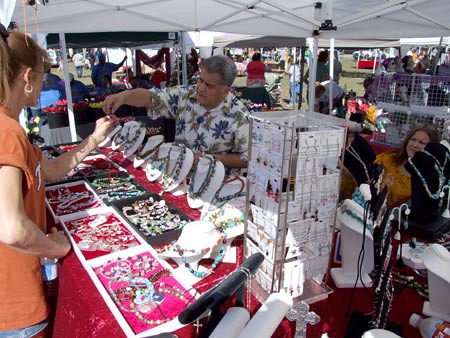
Jewelry booth at the Kyle Fair & Music Festival (2007)

As a small business, you should ALWAYS be looking for new customers. The best way to reach new customers is by being a good, solid business that people WANT to check out.  Make sure your house is in order. Do you make sure you provide a positive experience to each and every person who comes through your door? Do they WANT to come back? Would they tell others to swing by when asked if they know a place to get the product you sell?


The question remains, how do you reach people you don’t know? Where do you find new customers? Here’s three places you are likely to find new folks.


Word of Mouth

Cost: Free

This is the most powerful kind of promotion and it’s also sometimes the most dangerous. It’s powerful because people ask their trusted connections for advice on where to buy things. If your circle of friends tells their circle of friends about you… and then they tell their friends… you’ve got a good thing going.


How is this dangerous? Two reasons. First, People tend not to share good experiences and/or recommend things to others. Secondly, negative news travels faster than anything I’ve ever seen along the information highway. Want to test it? Post something positive about a local business on social media. You will likely get 4-5 replies and a handful of “likes.” Now, post about a negative experience on the same page…. And watch it BLOW UP.


As a journalist, I’ve written stories and features on a variety of subjects and also kept a personal blog. I have a rule that I guide myself by and that is to only talk positive. Personally, there is so much negativity in the world that I don’t believe I need to add to it. But, every now and then I have what I call “soapbox moments” or something I feel so strongly about that I feel I need to let the world know.  In 2009 I had an issue with a contact lens company that wouldn’t honor my coupon. I blogged about it. I have over 2,000 hits on it and 7 comments.  That was without posting it past my personal social media. It’s my 4th most read post on my blog of 11 years (467 blog posts.. this will be 468).  


The point is…. Bad news travels MUCH faster than good news. So, make sure each customer walks out with good news to share. And there’s no fault in asking people to share about your business… and invite their friends to swing by.


Participate In Events

Cost: Moderate

Is there a 5k happening in your area? How about a Farmer’s Market? A festival or celebration? Community gathering? Events at schools or businesses that allow vendors? Be there. Especially if it’s free or has a low cost of entry to reach a great amount of people. Especially if you have a product that you can set up in a booth and sell.


But here’s the deal with events. They can be a great experience or a horrible waste of time. There’s a little “luck of the draw” when you participate. Make no mistake, though… they are what YOU make of it. If you sit in a chair and let people walk by you and when they stop you shrug and say “grab a flier if you want” you’re likely not going to have a positive experience… but it may not be the fault of the event… it may be because of your attitude.  On the other hand, if something is poorly attended and you are a shining light of positivity and have fun and make sure that everyone is aware of you and your product, you might gain a good amount of interest in your product and people may talk about you. 


Advertise

Cost: Medium - Heavy

Every facet of your business is advertising. Your storefront is advertising, your product labeling is advertising, the signs you post, the sticker you have on your car, the shirts you and/or your employees wear… all advertising.


But I’m more talking about the outward advertising here. I posted a recent blog with five ideas to promote your business for free – link – so I’ll stick to some that have a price tag to them.  Now… let’s note that you MUST have a strong message and action to go with your advertising or it doesn’t matter what you’re selling.


On a small scale, having fliers and cards to hand out is a good idea. ALWAYS have some handy. Make sure people you talk to about your business walk away with something in their hand that enables them to reach you and/or find your store when they’re ready to purchase something. Advertising collateral is key to marketing yourself.


Are you in a niche market? Is there a trade show for your product? If you sell pet products, there’s a Global Pet Expo coming up (link). If you sell decks, there are several woodworking trade shows coming up (link). If your product is perfect for a wedding party, check out the Bridal Shows coming up (link). There is likely a Trade Show on a scale you can afford to match your business and help you get introduced to new customers. Google “your business” and Trade Show to see if there’s something there for you. Oh, and make sure you have advertising collateral.


Do you have a commercial? You can either do it yourself or (I recommend) hire a professional to shoot a video about your product. Once you have a 15-second, 30-second, and 1-minute commercial shot, you can post it up to YouTube and share it via the Internet. Also, you have something you can take to Internet shows, websites, television stations and even radio (audio only of course) to help promote yourself. Dealing with buying media is a slippery slope though, so having someone who knows how to deal with salespeople in these positions is key to get the best deal possible for your money. 


This is a commercial for a small, local business in the town where I live. Lone Star Delights.


These three things are not the only way to get your word out and meet new customers, but they are all good starting points. This article is just an aide to hopefully get you to thinking outside your network of friends and into the world. Thanks for reading.


 About The Author:
Sean Claes has worked with Mom and Pop shops, International Corporations and the Music Industry on their branding, marketing, events and communications for more than 15 years. This article is just a sample of the observations he's made over the course of that time. For more information or to see how he might be able to help grow your business, contact him at seanclaesATseanclaesDOTcom.
Read more Small Business Advice via his Small Business Marketing page - link.
February 10, 2016

Small Business Advice - Does the Owner Need To Develop A Work Persona?


Should You Develop A Work Persona?


Image found on businessnewsdaily.com


By Sean Claes

You opened your own business because you had a great idea and the want/need to be your own boss. That is fantastic! Now, you’ve secured a location, set up shop and stocked it with the things that you’d like to sell. Be it plumbing supplies, hand-made pottery, clothing or something else… they are the things that you hope people will want and moreover want to buy from YOU.


Now… a question you may have not taken time to consider… 


Who are you as a business owner?

It’s a real question.  It’s not necessarily who you are in your non-work life. In order to have the best chance of success, you should consider developing a work persona.


What is a work persona?

It’s kind of like acting… but it’s acting like yourself on your best behavior. You should be the best you on your best day… everyday for every customer. Think about it, in every job you've had, you've developed a different version of yourself... held back certain opinions...talked differently to co-workers than you do your family & friends... likely had a better attitude. That's a persona. As an owner, you're work persona is much more important. It sometimes defines the business.

Here are some things to think about when developing a work persona:


- It’s Not About You.

If someone walks in your door (no matter how well you know them in real life) and asks you how your day is going… don’t tell them. They just walked into your place of business… not your counseling or complaining session. You are there to serve them, not use them as a sounding board for your grievances. Things are going well.. and how can you help them?


- Sidestep Uncomfortable Conversations
If a customer complains about something that you have a great opinion on… don’t share it. They are in your shop and anything you say will reflect on your entire business. It’s not just YOUR opinion anymore; it’s the opinion of your entire company. If it's not an opinion that defines the product you're selling (I'd be surprised if a gun store wouldn't weigh in on something like Open Carry), don't comment. If I'm picking up a pizza from you, I don't want to hear your opinions on the Affordable Care Act. 


- Practice Safe Social Media.

Think very seriously about your social media posts. Make sure that your business Facebook page (you DO have one.. right?) posts helpful and positive things. When shopping I want to know about all of the great things you have for sale. Perhaps you can even post some funny memes that are related to your business or some stories that have come out in the news / magazines that are related to what you do. Keep it positive and make sure to invite them into your store.


Your personal Facebook page is your own… do with it as you wish… but make sure to use the “friends only” option when posting so only those who you have let into your inner realm can see those.


- Are You Part Of What You’re Selling?

Do you want to be the face of the business? If so, make sure you post about you along with your product for sale. Remember, part of owning a small business is trying to differentiate yourself from the competition. And ANYONE who sells something like yours is competition. What do you have that they don’t? To the untrained consumer… the difference is… YOU.


It’s the reward and burden of a small business. I have been treated poorly at a big box store and have ultimately gone back because they are cheaper than anywhere else. Likewise, I have been wronged by small business folks and I will NOT spend another dime with them. Now, I’m not the person who posts negative things on social media (but there are many who do), but if someone asks me what I think about a certain local business person, I may just tell them.


Why the double standard? Well, personally, I know I’m going to spend more money going to the small business owner (and most people who shop with you do as well) and that’s OK with me. But if the owner is a jerk to me or my kids, gives me bad service, and complains when I walk in… well. They just lost my business.


So… small business owners? If you aren’t a happy-go-lucky person who wants to make sure the customer is satisfied and walks out of your business’s door smiling and wanting to tell everyone they know about the great experience they just had... you might want to develop a work persona who IS that person. Now, I’m not saying be fake. I’m saying be the best you possible.


If that doesn’t work, you might want to find someone to work the storefront of your business and/or take the calls that CAN pull that off.  There ARE some people who should be “back of the house” instead of “front of the house” owners (borrowing the phrases from the restaurant world). You’ll be rewarded in sales.


Thanks for taking the time to read this. Your work persona can help elevate your business to the next level, or it may just turn your dream into a nightmare. Choose wisely. People talk.


About The Author:
Sean Claes has worked with Mom and Pop shops, International Corporations and the Music Industry on their branding, marketing, events and communications for more than 15 years. This article is just a sample of the observations he's made over the course of that time. For more information or to see how he might be able to help grow your business, contact him at seanclaesATseanclaesDOTcom.

More advice can be found in Claes' 52 Week of DIY Music Advice - a series he wrote between 2010-2012 - link

February 1, 2016

PROMOTE YOURSELF FOR FREE - Small Business Promo Ideas

Five Ideas To Promote Your Small Business for Free

By Sean Claes

I live in a County with no dedicated radio or television station. It has been a bedroom community that is situated in between two large markets, but itself has no major outlet for advertising. Yes, there's a weekly newspaper and the major cities within 30 minutes cover the county on their news when something tragic, ironic or newsworthy happens... but that's about it. People don't typically drive from the big town to the small town to shop, but folks who live in the small town regularly drive to the larger city.


Does this place sound familiar?

It's where many small mom & pop businesses set up shop. It's where they live, raise their families and want to make a living. It's the home of the American Dream for many.

If you own a small business in a setting like this, you've got your work cut out for you when it comes to promoting and advertising. How do you reach the people who live in your community in a way that is economically feasible and will reach the largest number of people?

How do you make a name for yourself and cause people to swing by your shop and spend money?

In this article I'm going to talk about a few outside the box ideas that might help you move your business forward. I'm going to talk about different vehicles you can use to get word out about your business. Now.. what I'm NOT talking about in this article is your message. Message is 80% of the equation. HOW you ask for business is the biggest key.. and I'll talk about that in a future article.

Today, I'll talk about a few creative promotional ideas that can help you reach customers without the aid of the big three (radio/television/print media).

1. Social Media
I could write a book on how to properly use Facebook for a small business... but while Facebook is a medium on social media, Facebook and not Social Media. Yelp, Twitter, Google Plus, Instagram and Linked-In are additional resources where you should likely have a presence. All are effective tools if you use them right.

To promote your business on social media takes time and dedication... but the good thing is.. it's vastly free. You can update folks on your newest products, let them know why they should care about your products, what you can do for them, have a little fun and create an online atmosphere that represents what your store is like.

Every post is a relationship deepener. Every Instagram picture invites them into your shop. Every tweet pushes the reader closer or further from gracing the front door of your establishment. And... just like every engagement shows a little about your business... lack of engagement is about as telling as a closed sign on your front door. So if you get on social media... you're signing on for a long and slow buildup... it can't become stagnant. You must post at least 3 times a week. Every week.

2. Fliers/Posters
I did a series of  blogs a few years back to help indie bands promote themselves (link). One of the things I still believe strongly in is fliers and posters. Small towns have several areas (and businesses) that allow you to hang up fliers and/or posters.

The non-profit I helped form has a monthly concert series. We decided to print fliers to promote our shows. We got together with a pizza place in town and they  agreed to stick our fliers on their pizza boxes. Every customer of theirs gets an invitation to the show. I've seen a local Dojo do the same.

If you're a member of a social group... make sure you bring a stack of fliers to meetings. If you go to an event in town, hand out fliers there. Every chance you get... try and introduce yourself to a new customer and have them walk away with knowledge and some incentive to come to your store.

Hanging up (and handing out) promotional fliers and/or posters in your own establishment with specials and/or events coming up is also highly recommended.

3. Small Business Sharing
This one, I think, is key. Small businesses in different areas should be working together to help each other out. In my town there is a gathering of small business owners that work together via a "secret" group on Facebook. This way they can, in their own time, be able to pitch ideas and work together to introduce their clients to other businesses. There are also numerous networking groups and small business support groups that get together to share best practices and ideas. If there isn't one in your area, start one. The key to success is to always work on promoting yourself and others who are your contemporaries.

4. Events
If you have a storefront, inviting the world to your door is important. One way to do this is to host events. Kids birthday parties, book clubs, bible studies, fundraising for a local non-profit, music, something to support a local sports team, a backyard BBQ, anything that brings a group of people together at your store where they invite their friends and supporters to visit as well. Heck, be a drop-off point for a local toy or food drive.

 Anything helps. Organizations are ALWAYS looking for a place to host their events. Be that place. If you don't feel comfortable organizing an event, just make your place of business available and let them come to you. 

5. Get On The Street
The city where I live has a train that comes through about twice an hour. Cars are stopped...and because of the laws (that everyone obeys, right?) there is no using of cell phones in the car. So... they are just waiting for the train.


I'm helping promote a dessert place that is located about 1/2 block off the main street where the train passes. I suggested when the train stops... to go out and hand out samples and coupons to the cars waiting. This accomplishes a few things. You get to tell folks about your business... give them a sample of one of your products... point them to exactly where your store is.. invite them to swing by.. and give them a flier/coupon so they'll remember you. 


---


There are many more ways to promote your small business. These are just a few of the free options. In life and business it is said that between Time, Money and Quality you can pick two. This article is about spending the time to make sure you have quality without spending a lot of money. And most small businesses don't have stacks of cash to throw around.


About The Author:
Sean Claes has worked with Mom and Pop shops, International Corporations and the Music Industry on their branding, marketing, events and communications for more than 15 years. This article is just a sample of the observations he's made over the course of that time. For more information or to see how he might be able to help grow your business, contact him at seanclaesATseanclaesDOTcom.

More advice can be found in Claes' 52 Week of DIY Music Advice - a series he wrote between 2010-2012 - link


January 22, 2016

7 Steps To Running A Successful Small Business

7 Steps To Running A Successful Small Business

A collage of Kyle, Texas - home of many small businesses.

By: Sean Claes
  
If you have a small business, this article is for you. Heck... if you have a large company, this is still solid advice... but most folks who run large businesses have a team of people who are looking over details such as these. Owner-operator businesses, much of the time, have to learn these points as they go. Note: This is not "THE 7 Steps To Running A Successful Small Business" but below you will find seven helpful steps to move you in the right direction. Happy reading, my friend.

1. Don't Worry. Be Happy with Customers.

If you walked into a store and the person behind the counter didn't greet you, didn't smile and didn't make you feel welcome, would you tell all of your friends to go to that store? Likely not. I know that I have personally turned around and walked out of a business that didn't greet me.  

This is really Retail 101. Customer Service. Put on a happy face. The customer doesn't care that you've had a cruddy day and have your head filled with money, personnel or life problems. They came in to be served, have a positive experience and to purchase a product. Your job is to be there to happily answer questions, be a positive point in their day and make sure they walk out in a better mood than they had when they walked in. 

An example of a small business that has done this well is Austin, Texas' Amy's Ice Cream. At the core of it, it's just an expensive ice cream shop... but kids and adults alike seek this establishment out because of the culture. It's an experience each time you enter. 

Of course, there's always angry people who aren't going to be swayed by your kindness... be even kinder to them. These folks are looking for any reason not to come back... don't give them one.

2. The Power of Positive.

I can't tell you how many times I've talked with small business owners who complain about all of the things that are out of their control. What their competition is doing, who is talking ill of them on social media, all the ways the local small business support systems in their town are not serving them or can't offer what they want. And that is me as a customer. I know I don't want to walk out thinking "those poor folks are just trying to make it." I want to walk out thinking "That was nice. They have great products and are good people."

Does HEB complain about what Wal-Mart is doing? No. They talk about the great things that are happening within their walls. Their products. Their people. Their events... and how it makes like better for the customer. HEB's slogan is "Here, Everything's Better." How much more positive can you get there?

3. Accentuate Perceived Negatives.

Say the things that people are thinking. 
- Are you in a bad location? Well... you're a little hard to find, but well worth the effort. 
- Are your prices more expensive? Well... you may cost you a little bit more, but the quality of your product is vastly superior. 
- Are you a small shop with few offerings? Well... you focus on a few things, but do them amazingly well.

List out all of the things that you've heard or could be said about your business and find a way to tell it with a positive light.

4. Don't Guilt People.

I've heard the something similar to this when talking with small businesses: "Don't buy a CEO another vacation home, help us send our kids to dance lessons." That is a sure way NOT to get me to shop there. Why? Because I can say that shopping at a big box store not only helps the CEO, but it could help THOUSANDS of people send their children to dance lessons. Sure, I'll never meet them, but it's true. You employ under 10 people. They employ thousands.

5. Think ROI In All Things.

I am helping out at a small business. The customer base is small but building as people learn of the shop. Working there one Saturday, I almost had an equal number of people coming in to sell me advertisements* as I did coming in to shop. There are coupon pages, newspapers, radio, online ads, magazines, trade journals, billboards, television... you could go broke promoting yourself... and a lot of folks do. 

Think about the ROI or return on investment.. I'd suggest concentrating on one thing and doing it well instead of sprinkling your money here and there. If I throw birdseed in my front yard, a few birds will find the seed in several different places. If I set up a bird feeder, it'll all be gone at the end of the day because so many birds visit. Why? Because I provided an incentive (seed) and placed it in a place they would be sure to see it (bird feeder) instead of throwing it out and hoping something would stick.
* Side note: Nobody that wanted the business to buy an ad bought the product.. or seemed interested in it at all. If you sell advertising... try supporting the business that you're asking for money from. It works.

6. Budget For Charity.

Everybody has a cause. All of them are important. If you are a business you will be inundated with people asking for your support. Asking for money. Asking for you to sponsor their event. Do yourself a favor. Define what cause is important to you and get behind that cause. Define the amount of money you are willing to set aside this year to support that cause and don't feel bad when you can't support everything. People won't speak ill of you if you don't support something they're passionate about... and if they do... well, they probably weren't your customer to begin with. 

No rational person should find fault in "We have decided that this year we're putting our charitable contributions towards (cause). We plan our budget in January, so we'd love to see a proposal from you in December to see if it's something we can do next year."

Between you and me, out of 100 people who ask your for $$ I'm guessing less than 10 will get back to you in December.

7. Define Who You Are
This is the final point in this article, but it should be first on your list of to-dos. Do you have a solid definition of who you are as a company and what you stand for? Do you have a look and feel that is consistent? Can someone look at an ad for your business and know it's yours, no matter where they see it? 

If not, it doesn't matter how much $$ you throw at advertising, you're not creating a brand. Sit down, take some time, maybe even consult a professional, and define who you are. Who would you like to be? For what you would like to be known? 

Have you ever heard the term "Elevator Speech?" All businesses should have one. In 3-5 sentences, how would you describe your business and the services you provide? Having something like this is the blueprint to how you should market your business. 

Thanks for taking the time to read this. There is much, much more to consider than what I've pointed out above, but this is a good starting point. You started your own business with the idea to succeed, right? Well, it takes a great product that has some demand lot of work to make that happen. I want you to succeed. Hopefully you can read this and see a few things you might do differently.


About The Author:
Sean Claes has worked with Mom and Pop shops, International Corporations and the Music Industry on their branding, marketing, events and communications for more than 15 years. This article is just a sample of the observations he's made over the course of that time. For more information or to see how he might be able to help grow your business, contact him at seanclaesATseanclaesDOTcom.

More advice can be found in Claes' 52 Week of DIY Music Advice - a series he wrote between 2010-2012 - link